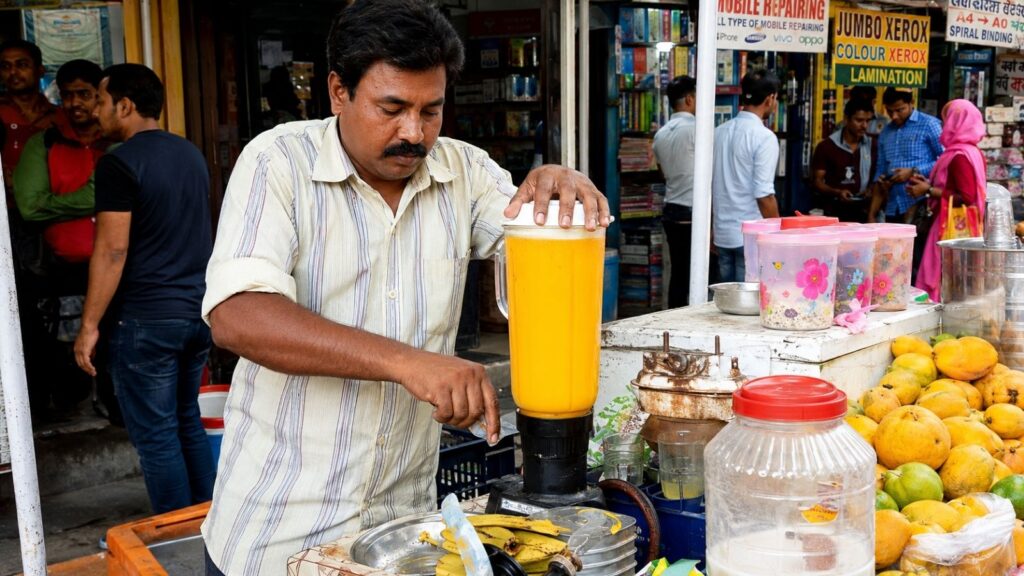
If there is one drink that defines summer in Kolkata, it is mango lassi — cold, creamy, and somehow capable of making 42-degree heat feel survivable.
Close your eyes for a moment.
It is May. The Kolkata sun is doing what it always does — burning without apology. The humidity wraps around you like a second skin you never asked for. Your shirt is damp. Your shoes feel heavy. The city smells of dust, marigolds, and something frying somewhere nearby.
And then — you spot it.
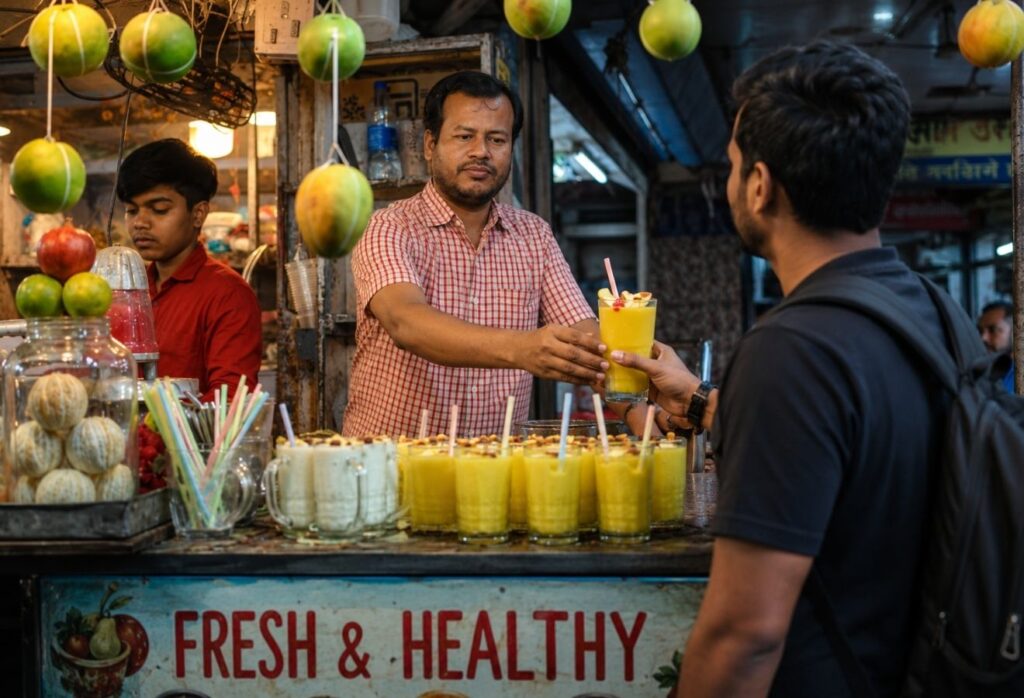
A man behind a small counter. A steel blender whirring furiously. A thick, golden pour cascading into a tall glass. A cloud of cold mist rising as it hits the humid air.
You take one sip. And somehow, in that single moment, Kolkata becomes bearable again.
This is not just a drink. In Kolkata, mango lassi is a ritual, a rescue, and a rite of passage — all served in one tall, frosty glass.
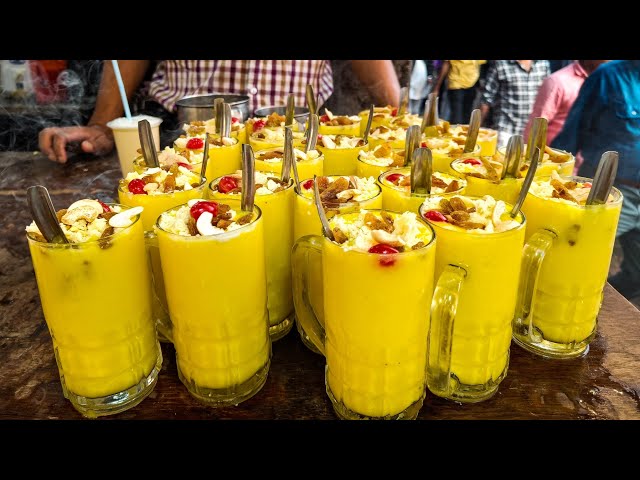
Table of Contents
Where Did It All Begin? The Ancient Story of Lassi
Before we talk about Kolkata’s favourite summer drink, let us go back — way, way back.
Historians trace lassi’s origins to ancient Punjab around 1000 BC, making it quite possibly the world’s oldest smoothie. It began as a simple blend of curd, water, and spices — made not for pleasure alone, but for purpose. Ancient Ayurvedic texts praised it as a digestive aid, a body coolant, and a drink that calmed both the stomach and the mind. In a land of scorching summers and heavy, spiced meals, lassi was medicine that tasted good.
The word “lassi” itself carries debate. Some trace it to the Sanskrit word lasika, meaning “buttermilk,” while others link it to an ancient term for the drink’s characteristic frothy, thick texture. Either way, the name stuck — and so did the drink.
For centuries, lassi was primarily salty or plain, churned in clay pots and served in kulhars — small earthen cups that kept the drink cool long before refrigerators existed. The addition of fruit came naturally, because in India, where mangoes have been cultivated for over 4,000 years and are considered a symbol of prosperity and good fortune, it was only a matter of time before someone dropped a fistful of ripe mango pulp into the curd and blended the two together.
Some food historians believe mango lassi as a distinct drink emerged during the Mughal Empire, between the 16th and 18th centuries. The Mughals were famously obsessed with mangoes — Emperor Akbar reportedly had over a hundred thousand mango trees planted in his orchard at Darbhanga. With royalty celebrating the fruit so passionately, it is easy to imagine mango lassi finding its way into royal kitchens and eventually into every roadside stall across the subcontinent.
From Punjab, the drink travelled east. And when it reached Bengal — with its own rich tradition of curd-based sweets and dairy culture — Kolkata gave mango lassi something no other city quite could: a local soul.
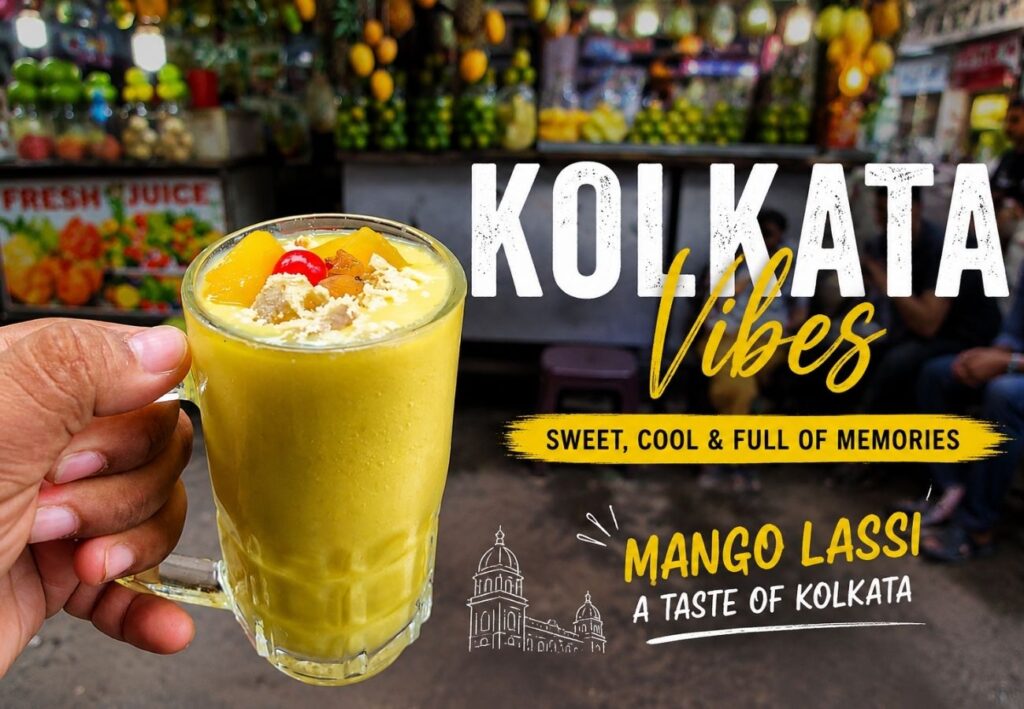
Why Mango Lassi in Kolkata Hits Different in Summer
Here is the thing about Kolkata summers that outsiders never fully grasp: the heat here is not just hot. It is heavy. The mercury climbs past 40 degrees, and the humidity turns the air into something you could almost chew. Ceiling fans push warm air in slow, lazy circles. Even the crows look tired.
In this context, mango lassi is not a beverage. It is a survival strategy.
But beyond the heat, there is something deeper here. Kolkata has always had an intimate relationship with dairy. This is the city of mishti doi, of sandesh, of rabri — where curd is not just an ingredient but an art form. Bengali curd is thick, slightly tangy, and deeply flavourful in a way that store-bought yogurt simply cannot replicate. When you blend that curd with the ripe Himsagar or Langra mangoes that flood the city’s markets every May and June, you get something that tastes distinctly Kolkatan — even if the drink’s roots lie a thousand miles west in Punjab.
And then there is the Bengali love of the mango itself. The arrival of aam (mango) season in Kolkata is a cultural event. Families plan their mango purchases the way others plan holidays. Arguments about which variety is superior — Himsagar, Langra, Fazli, Gopalbhog — are conducted with the seriousness of cricket debates. So naturally, when the summer’s most beloved fruit meets the city’s most beloved dairy tradition, the result is a glass that Kolkata claims entirely as its own.
People here have mango lassi for breakfast, mid-morning, post-lunch, as a snack, and sometimes just because they walked past a stall that smelled too good to ignore. There is no wrong time for a glass in this city.
The Kolkata Twist: What Makes It Different Here
Walk into a Punjab-style dhaba and you will get a mango lassi that is thick, almost solid in its richness, with fresh cream floating on top. That is beautiful, but it is not Kolkata’s version.
Here, the best mango lassi tends to be slightly thinner — creamy, yes, but with a pourable flow that makes it easy to drink standing up at a stall. The curd is often set fresh that morning. The mango pulp comes from fruit that the stall owner himself has sourced from the market before dawn. No artificial flavouring, no mango-flavoured syrup from a bottle.
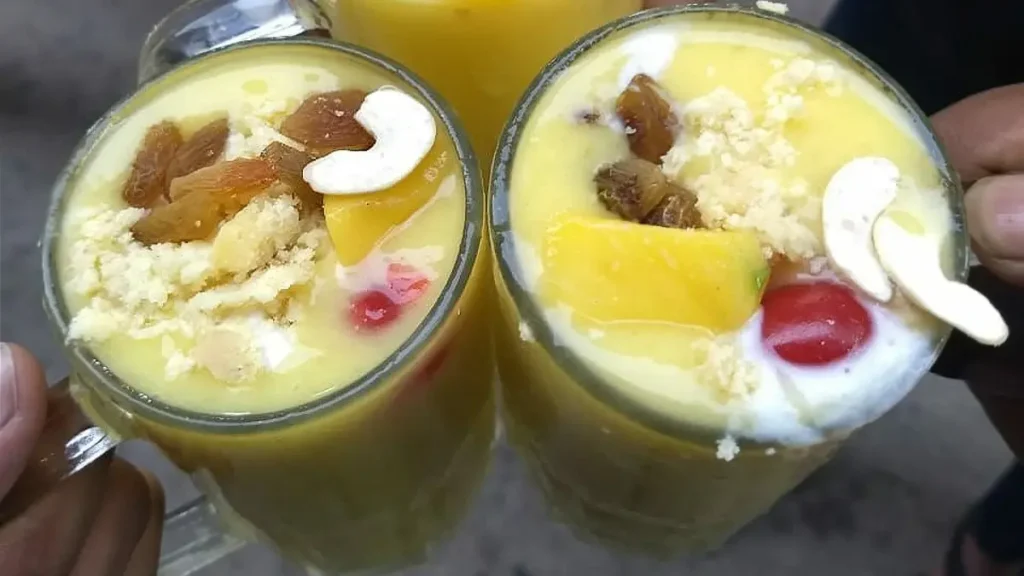
And then — Kolkata’s greatest contribution to this drink — the toppings. A well-made mango lassi in this city often arrives crowned with makha sandesh (a soft, crumbled Bengali sweet), a cherry or two, and a scattering of dry fruits. The sandesh slowly dissolves into the glass as you sip, adding a distinct sweetness and texture that you will not find anywhere else in the country.
In some stalls near North Kolkata, they serve it in the traditional kulhar — the earthen cup — which adds a faint, earthy flavour and keeps the drink cool longer than glass ever could.
Where to Find the Best Mango Lassi in Kolkata
Now, the question everyone actually came here for.
The Lane Beside Esplanade Post Office, Central Kolkata
This is ground zero for mango lassi lovers in the city. The small shop at the start of this lane has been pulling in crowds of office-goers, shoppers, and passers-by for years. The mango lassi here comes topped with makha sandesh, a cherry, and a handful of dry fruits — and the stall stays busy from morning until well into the evening. If you are in the Esplanade area and you do not stop here, you are doing the neighbourhood a disservice.
Shyambazar 5 Point Crossing — Near Lifeline Medical Store
The lane beside the Shyambazar 5 Point Crossing is a lassi lover’s dream hidden in plain sight. Multiple small shops line this lane, each serving freshly made lassi in a range of flavours — plain, mango, rose, green mango, chocolate. The mango variety here is especially popular: thick, cold, and served with a generous topping of dry fruits and sometimes a square of sandesh on the side.
Haldiram’s (Multiple Outlets Across Kolkata)
For those who want something more structured and predictable, Haldiram’s is an excellent option. With over five outlets across the city, it is accessible from almost any neighbourhood. Their mango lassi is consistent, well-made, and comes as part of a wider menu of lassi flavours including Kesar, Rose, Strawberry, and Rabri. It is not the street-side adventure of Esplanade, but it is Haldiram’s — and that name carries real weight.
Rang De Basanti Dhaba
If you want your mango lassi with a Punjabi accent, Rang De Basanti Dhaba is your destination. This place takes lassi seriously in the way that only a proper Punjabi kitchen can — heavy cream, thick curd, and a richness that makes the glass feel almost like a meal. They also serve Pede Wali Lassi, a specialty topped with peda and dry fruits straight from the lanes of Amritsar. Come hungry.
The Lassi Corner
A small, cosy café that has built a loyal following on the strength of its fruit lassis. The mango version here uses fresh fruit blended into a frothy base, and the café’s relaxed atmosphere makes it a good place to sit and actually enjoy your glass rather than drinking it standing up at a stall. They also offer interesting variations like Black Currant Lassi and Butterscotch Lassi if you want to experiment.
Paramount, College Street
Paramount is not primarily a lassi place — it is a 104-year-old institution famous for its sherbets and syrups. But the Cream Kesar Lassi here has developed a following of its own. It is rich, aromatic, and carries the kind of quiet confidence that comes from over a century of practice. Go for the history, stay for the glass.
Badha Ghat, Howrah
This one requires a short ferry ride across the Ganga, but locals will tell you it is completely worth it. Take the ferry to Howrah’s Badha Ghat, walk four minutes, and you will find a stall with big kulhars lined up and ready. The mango lassi here, served in earthen cups with the river breeze coming in off the Ganga, is a whole experience — not just a drink.
Upscale Options: The Hotels and Malls
If you are looking for mango lassi in a more refined setting, most of Kolkata’s major hotels serve it — Taj Bengal, The Oberoi Grand, ITC Sonar, Hyatt Regency. The malls have it too: South City Mall, City Centre 1 and 2, Forum Mall, Axis Mall. The quality is reliable and the air conditioning is a bonus, though admittedly some of the magic is lost when you are drinking it in a food court rather than on a sweaty street corner.
A Note on Why This Drink Refuses to Go Out of Fashion
Every summer, new drinks arrive in Kolkata. Cold brew coffee. Kombucha. Mango smoothie bowls. Fancy fruit juices in eco-friendly cups. And every summer, the mango lassi stalls are still the ones with the longest queues.
There is a reason for that.
Mango lassi does not require any explanation. It does not need a brand ambassador or an Instagram filter. It is simply cold, creamy, naturally sweet, and deeply satisfying in the exact way that your body craves on a 42-degree day in May. The probiotics in the curd settle your stomach. The mango gives you natural sugar and energy. The chill cuts through the humidity for exactly the few minutes you need it to.
It is also, importantly, affordable. A glass at a street stall costs between ₹30 and ₹80 depending on where you are. At Haldiram’s, a little more. At a five-star hotel, considerably more. But the drink itself — the essence of it — remains the same across price points: mango, curd, and cold.
That accessibility is part of why it belongs to everyone in this city. The man in the white collar stopping at the Esplanade stall is drinking the same thing as the student, the shopkeeper, and the rickshaw-puller who stopped at the same counter an hour before him.
In a city as layered and complex as Kolkata, there are not many things that cross every boundary that easily.
Mango lassi does.
How to Make Kolkata-Style Mango Lassi at Home
If you cannot make it to one of the stalls above, here is the closest you can get at home.
Take two cups of fresh, thick curd — ideally Bengali mishti doi or a good full-fat homemade dahi. Add one cup of ripe mango pulp, freshly made from Himsagar or Langra mangoes if you can find them. Add one tablespoon of sugar or a small amount of honey. Blend until smooth and frothy. Pour into a tall glass over ice. Top with a crumble of soft sandesh, a few raisins, and a cashew or two.
Sit near a window. Drink slowly.
It will not be quite the same as standing at the Esplanade stall in the heat, drink in hand, city roaring around you. But it will come close.
Read Previous Blog: Buffet in Kolkata Under 500
Final Sip
Kolkata has a long list of iconic foods — kathi rolls, mishti doi, biryani from Park Circus, puchka on Park Street. Mango lassi belongs on that list, even if it was not born here.
Because what Kolkata did was take something ancient and make it its own — added the sandesh, the kulhar, the river breeze, the roadside chaos — and turned a simple blended drink into something that feels, unmistakably, like this city.
So this summer, when the heat gets too much and the city feels like it is being slow-roasted from above, you know what to do.
Find a stall. Order a glass. Take a sip.
Kolkata will feel exactly right again.
Where can I find the best mango lassi in Kolkata?
The best mango lassi in Kolkata is found at the street stall beside the Esplanade Post Office, the lassi shops near Shyambazar 5 Point Crossing, and at Haldiram’s outlets across the city. For a traditional experience, look for stalls that serve it in kulhars (earthen cups) topped with makha sandesh and dry fruits.
Why is mango lassi so popular in Kolkata during summer?
Kolkata’s extreme summer heat and high humidity make mango lassi the city’s go-to cooling drink. The combination of thick Bengali curd, fresh seasonal mangoes like Himsagar and Langra, and natural probiotics makes it both refreshing and filling. It is also affordable and available at nearly every street corner between April and July.
What makes Kolkata’s mango lassi different from other cities?
Kolkata’s mango lassi stands out because of its local toppings — makha sandesh (crumbled Bengali sweet), dry fruits, and sometimes a cherry — which you will not find in Punjab-style or south Indian versions. The curd used is often freshly set Bengali dahi, which is thicker and slightly tangier, giving the drink a distinct flavour that feels unique to the city.
Is mango lassi available year-round in Kolkata or only in summer?
Mango lassi is primarily a seasonal drink in Kolkata, available from late April through July when fresh mangoes — especially Himsagar, Langra, and Gopalbhog varieties — are in season. Some restaurants and chains like Haldiram’s offer it year-round using mango pulp, but the best, freshest versions are strictly a summer affair.