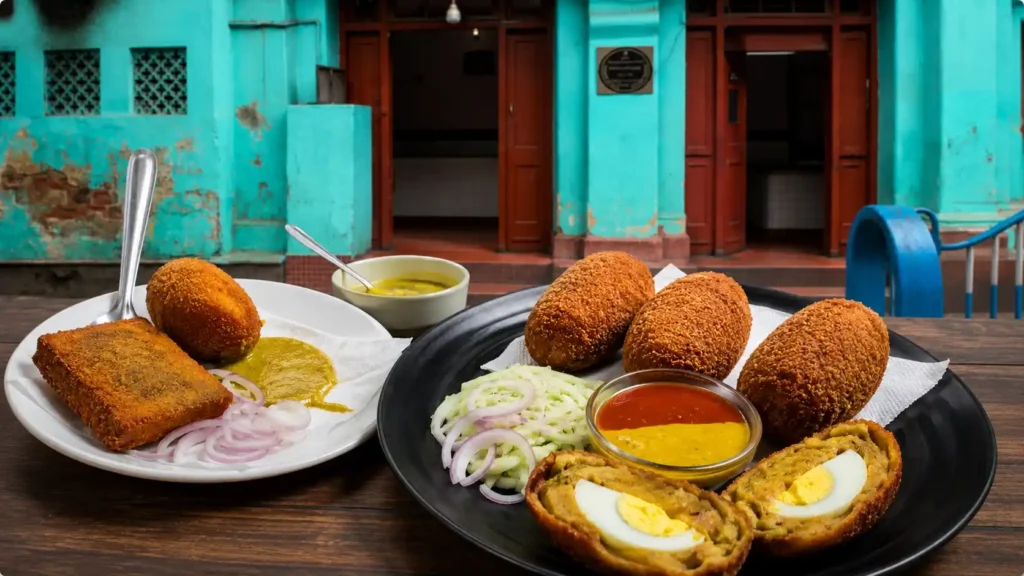
There’s a shop near Girish Park metro station that most people walk straight past. No signage worth a second look, no seating you’d call comfortable, just a narrow room with marble-top tables and strangers sharing benches because there’s nowhere else to sit. And yet, for over a hundred years, this has been one of the few places in Kolkata still making an egg dish the exact same way it always has — a dish most of the city eats without knowing where it actually came from.
It’s called Dimer Devil. And its story is a lot messier, and a lot more interesting, than most people assume.
Table of Contents
Dimer Devil: It’s Not What the Name Suggests
Say “devilled egg” to most people and they picture the Western version — a boiled egg, halved, the yolk mashed with mayonnaise and mustard, spooned back in. Cold, creamy, served at parties.
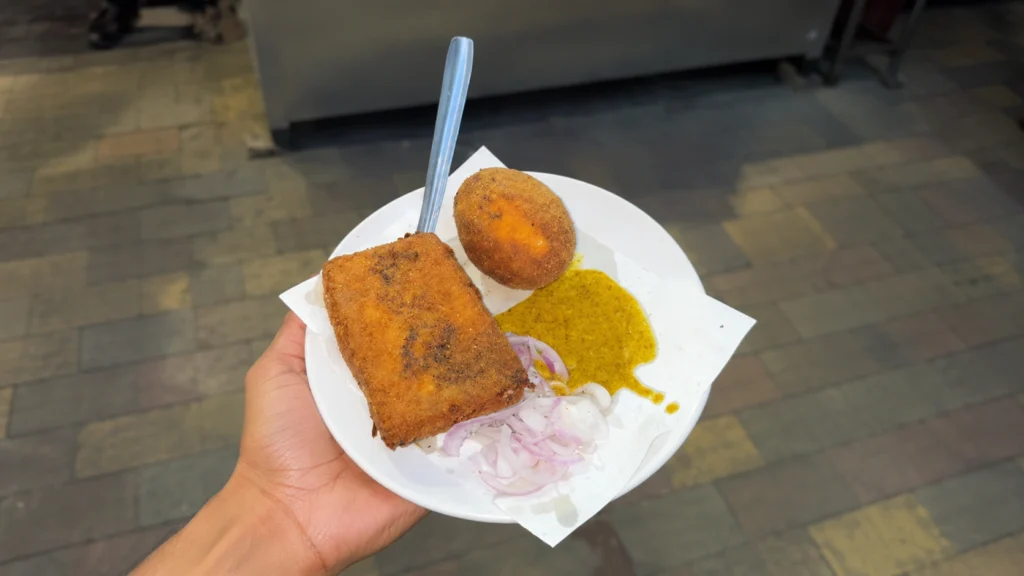
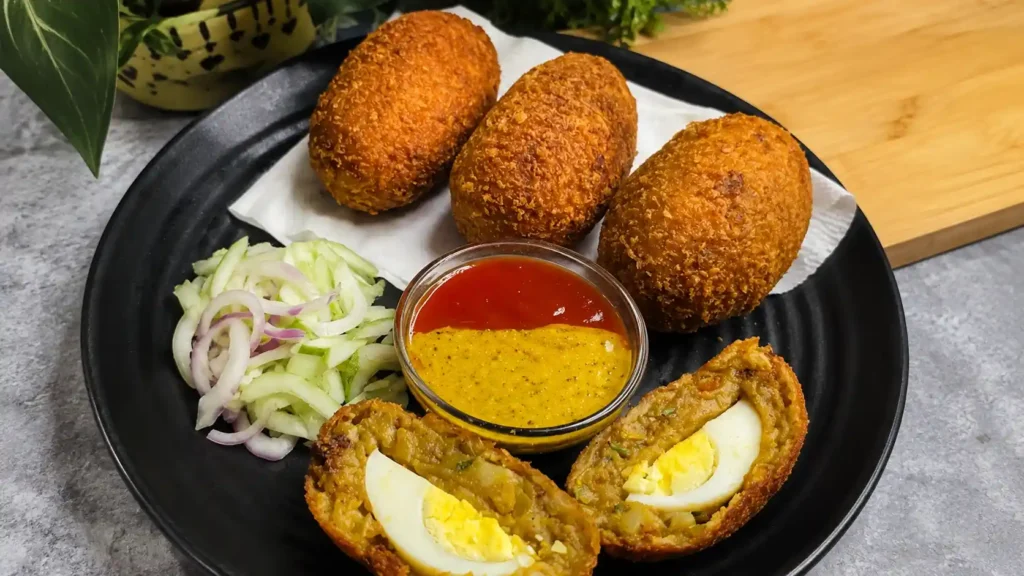
Dimer Devil has almost nothing to do with that. It’s a whole boiled egg — often a duck egg, prized for being richer and firmer than a regular hen’s egg — wrapped in a thick layer of spiced minced mutton or seasoned mashed potato, coated in breadcrumbs, and deep-fried until it’s dark gold on the outside. Crack it open and the egg is still soft and warm at the centre, sitting inside a shell of spice.
So where did the name come from, if it’s not actually a deviled egg at all? Food writers point to an old British habit of calling heavily spiced dishes “devilled” — back when spices were expensive enough that only the wealthy could afford to eat things this fiery. Somewhere along the way, a Bengali version of that idea picked up the name and just kept it, even after it turned into something completely different.
Nobody Actually Agrees on Where It Came From
This is the part that makes the story worth telling. Ask five Kolkata food historians where Dimer Devil actually came from, and you’ll likely get three different answers — and all of them sound reasonable.
One theory points to the British Scotch egg, a boiled egg wrapped in sausage meat and fried, said to have been popularised by the London store Fortnum & Mason in the late 1700s. British officers and their households brought the idea to colonial Calcutta, and local cooks — khansamas working in British and Anglo-Indian kitchens — adapted it with what they had: duck eggs, mustard oil, and the kind of bold spice mix an English recipe would never have called for.
The other theory goes back further, to the Mughal court dish Nargisi Kofta — a boiled egg encased in spiced minced meat, named after the narcissus flower because a sliced kofta was said to resemble its yellow-and-white bloom. If that’s the real ancestor, then Dimer Devil didn’t arrive with the British at all. It just met them halfway.
The honest answer is probably both. A Mughlai technique, reshaped by a colonial kitchen, finished off with a very Bengali hand for spice. Nobody can point to a single moment it was invented, because it likely wasn’t invented once — it was assembled, over decades, by cooks nobody bothered to credit.
A Dish That Almost Only Survives in a Handful of Old Cabins
For a long time, this was ordinary evening food — something clerks and traders picked up on their way home, sold hot out of small “cabin” eateries across North Kolkata. Niranjan Agar, the shop near Girish Park, is one of the last of that generation still standing. It opened in 1922, started by a man named Niranjan Hazra as a corner shop serving snacks to office-goers heading home for the day, and it’s still run by his family, now four generations deep.
Its Dimer Devil hasn’t changed much in a century — duck egg, a mutton keema layer worked with garam masala and slow-cooked onion, a crumb coating, and a mustard sauce on the side that cuts through the richness. It became popular enough, decades ago, that the shop was informally known around the city as the “King of Egg Devils,” and regulars still mention that the Bengali film star Uttam Kumar used to eat there.
But cabins like this are disappearing. Rents in North Kolkata have climbed, younger generations of these families often aren’t interested in running a hundred-year-old snack shop, and quick-service food has pulled a lot of foot traffic elsewhere. Dimer Devil hasn’t vanished — you’ll still find versions of it at Durga Puja food stalls and telebhaja counters across the city every monsoon — but the version made exactly the old way, in a place that’s been doing it since before India’s independence, is getting harder to find.
Why This Story Is Worth Knowing at All
Kolkata has no shortage of food with a colonial backstory — but most of it gets flattened into a single line: “the British brought this, Bengalis made it their own.” Dimer Devil is a better story than that, precisely because nobody can actually finish the sentence. It sits at the crossing point of a Mughal court dish, a British teatime snack, and a Bengali kitchen that took both and made something that belongs to neither.
That’s really what a lot of Kolkata’s food culture is — not one clean tradition, but several borrowed ones, refried and reseasoned until the borrowing itself is forgotten. Dimer Devil just happens to still be honest about it, if you know to ask.