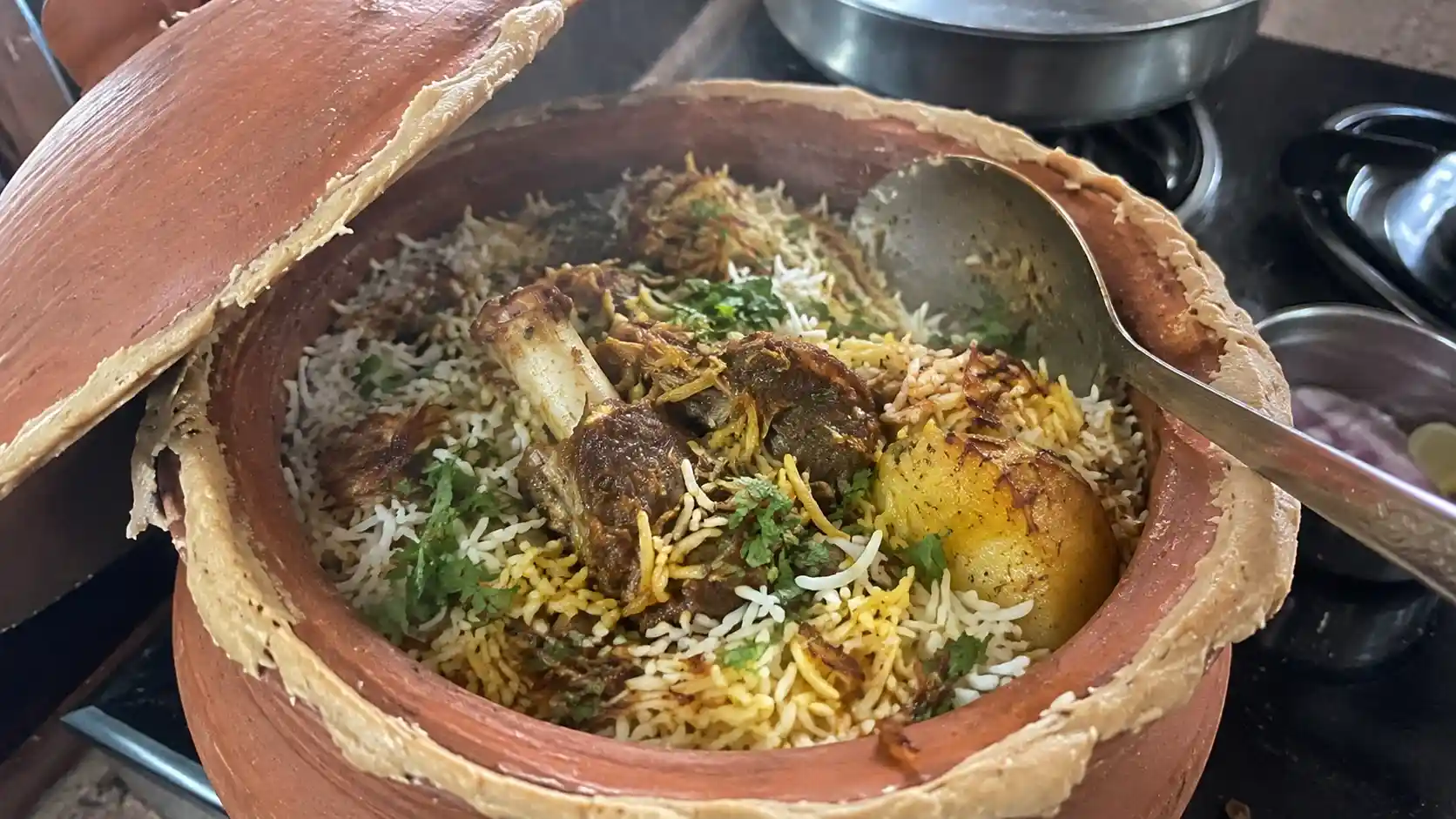
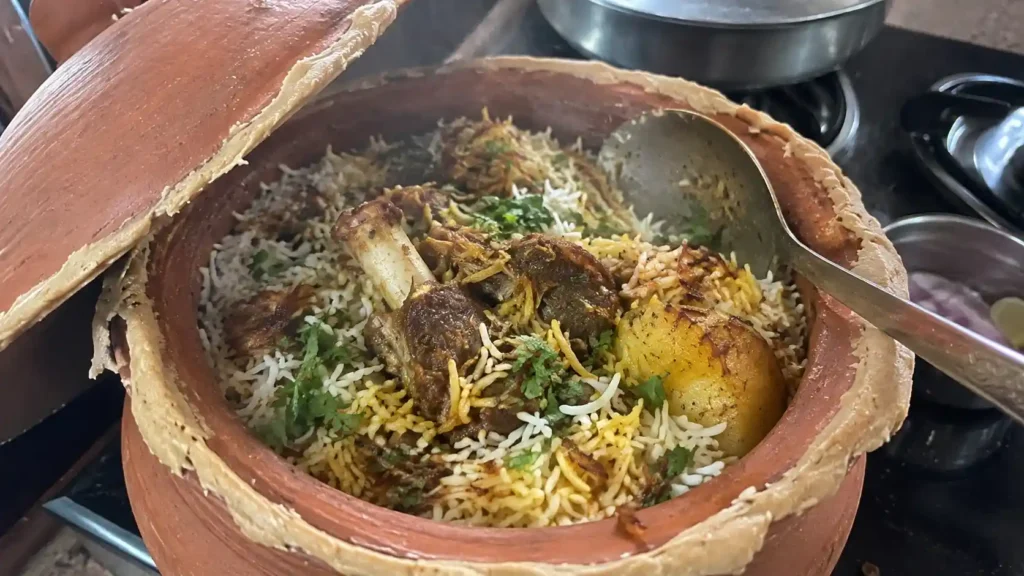
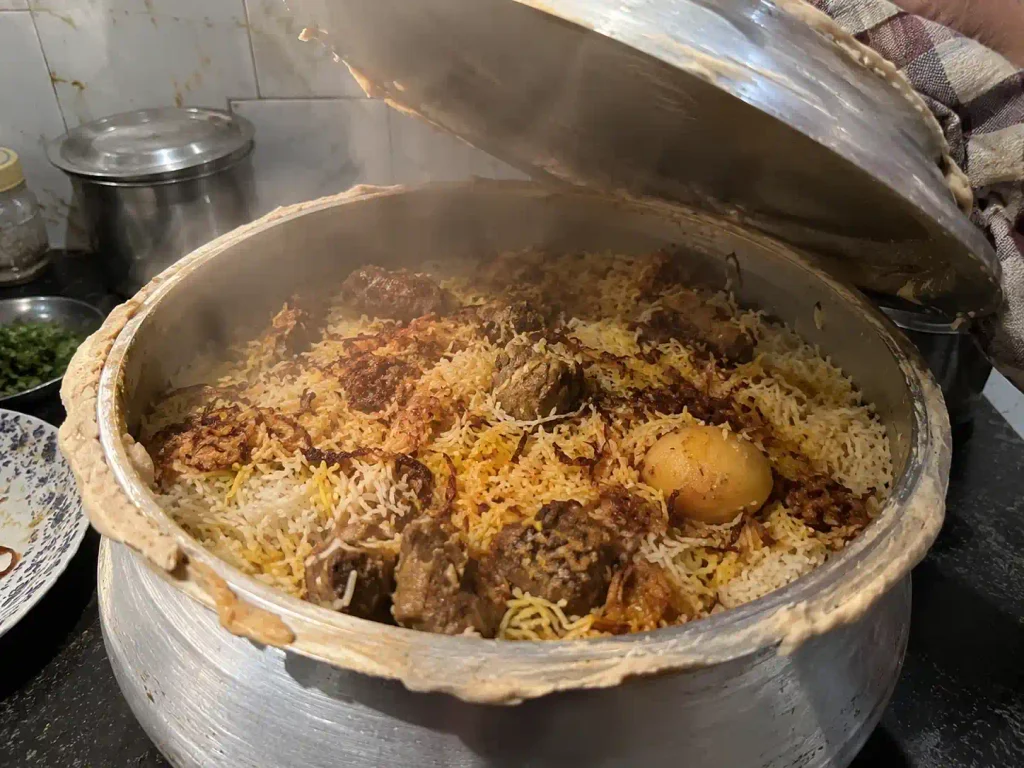
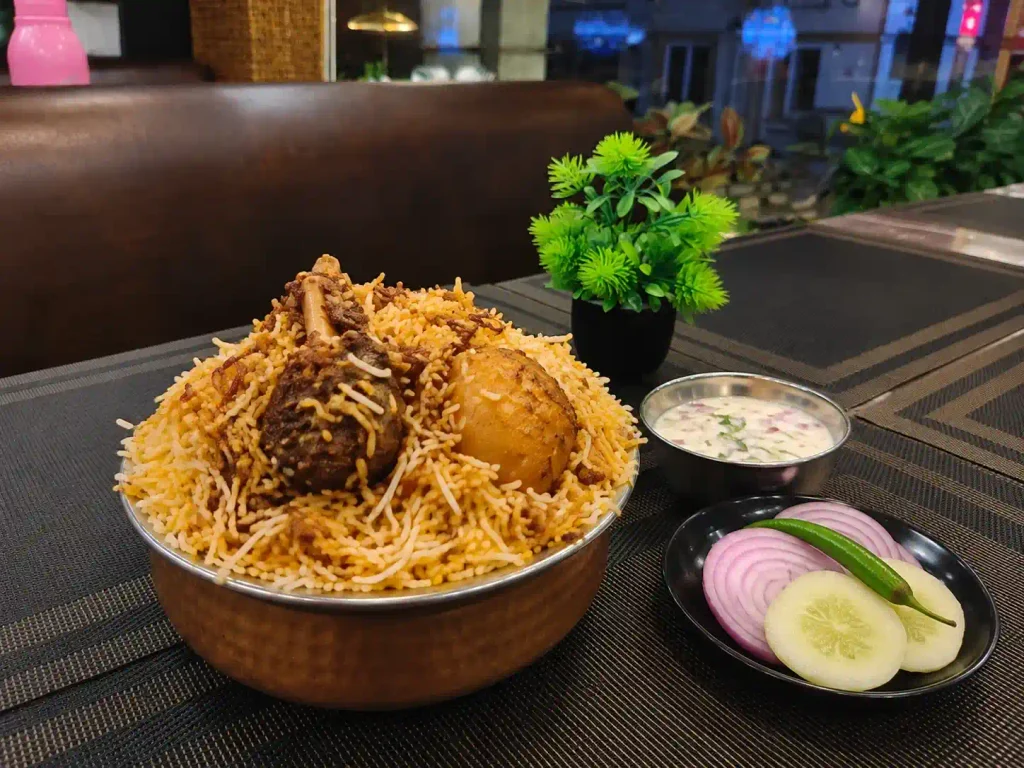
When the atta seal cracks and the lid lifts, a particular smell rises—kewra, saffron, rendered mutton fat and rice all at once. It arrives before the food does. Long grains, faintly gold. A large potato, almost amber where it touched the handi wall. Tender mutton sitting between the layers as though it never had anywhere else to be.
That is Kolkata mutton biryani. Not aggressive, not red, not chasing your palate with chilli heat. It comes quietly, lets the fragrance lead, and then stays with you.
It descends from the Awadhi dum tradition—food built on patience, layering and restraint—but a century and a half in Kolkata shaped it into something completely its own.
If you’re in Jadavpur and want the real thing without the effort, try our Mutton Special Biryani cooked slow, served with aloo, the way it should be.
Table of Contents
What Makes Kolkata Mutton Biryani Different?
Most biryanis announce themselves loudly. Hyderabadi carries heavy spicing and deeply coloured rice; Lucknowi is ivory-pale and almost whisper-soft. Kolkata biryani sits between them—fragrant rather than fiery, aromatic without being pungent.
The defining elements:
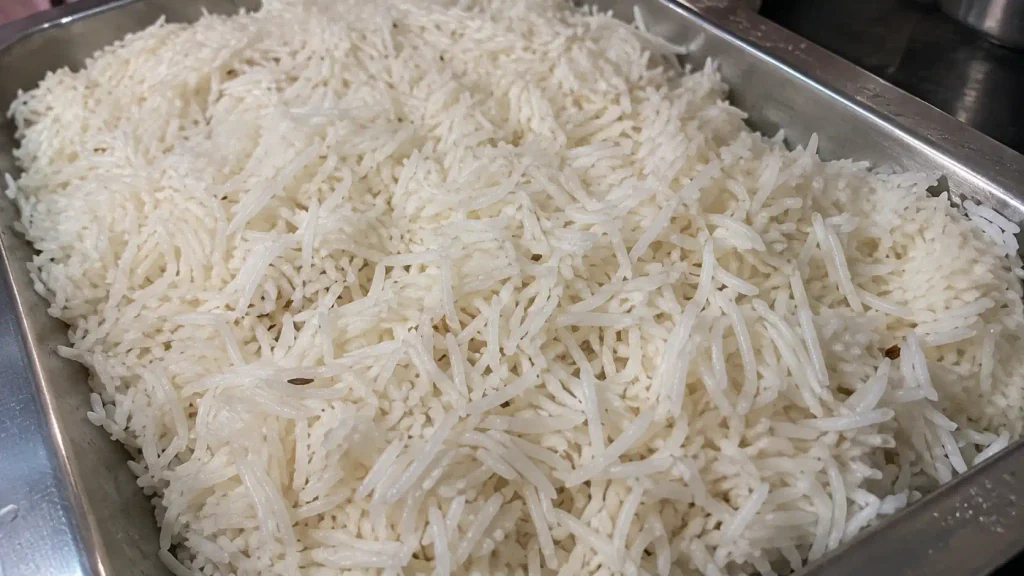
- The rice. Aged long-grain basmati, parboiled to about 80% doneness before layering, finishing on dum without going soft. Every grain should emerge separate.
- The mutton. Bone-in, large pieces (125–150g), marinated in hung yoghurt and deeply spiced, then cooked until flavourful but holding shape.
- The aloo. A large potato half, fried golden, finished in the dum. Not a side thought. More on this shortly.
- The aromatics. Kewra water, rose water, meetha attar, saffron milk—added in measured quantities during layering. The word is measured. An excess of any one of them tips the biryani from fragrant to perfumed.
- White ghee. Not the nutty brown ghee used in everyday Bengali cooking. Kolkata’s Mughlai restaurants have always used white ghee, and the difference in the finished dish is real.
The Story of Kolkata Biryani
In 1856, the British exiled Wajid Ali Shah, the last Nawab of Awadh, to Calcutta. He settled in Metiabruz, recreating a version of his court—his musicians, his poets, his bawarchis. Those cooks brought the Awadhi dum tradition with them and, over time, adapted it to their new city. Local ingredients entered the kitchen. The biryani changed.
What is established: the Awadhi lineage, the Metiabruz connection, the slow divergence of a distinct Kolkata style.
What remains in the territory of food lore: exactly why the potato appeared. Two competing theories exist. The first says the reduced royal household stretched ingredients—potato was cheap, adding aloo made the dish go further. The second, often cited by the Nawab’s descendants, holds the opposite: in mid-19th century Bengal, the potato was still a relatively recent import and something of a novelty. Adding it was a deliberate, almost prestigious choice.
Both are plausible. Neither has been definitively settled. The honest position is that we have engaging stories and a very good potato, and the provenance of how it got there is genuinely debated.
Why Does Kolkata Biryani Have Aloo?
History aside, the aloo earns its place by what it does.
Potatoes absorb. During dum, as the mutton releases fat and spiced stock steams upward, the potato—half-fried, porous—soaks it all in. Mutton rogan, ghee, the faint sweetness of kewra, the bitterness of whole spices. By the time the handi opens, the aloo has become something distinct from the potato you put in.
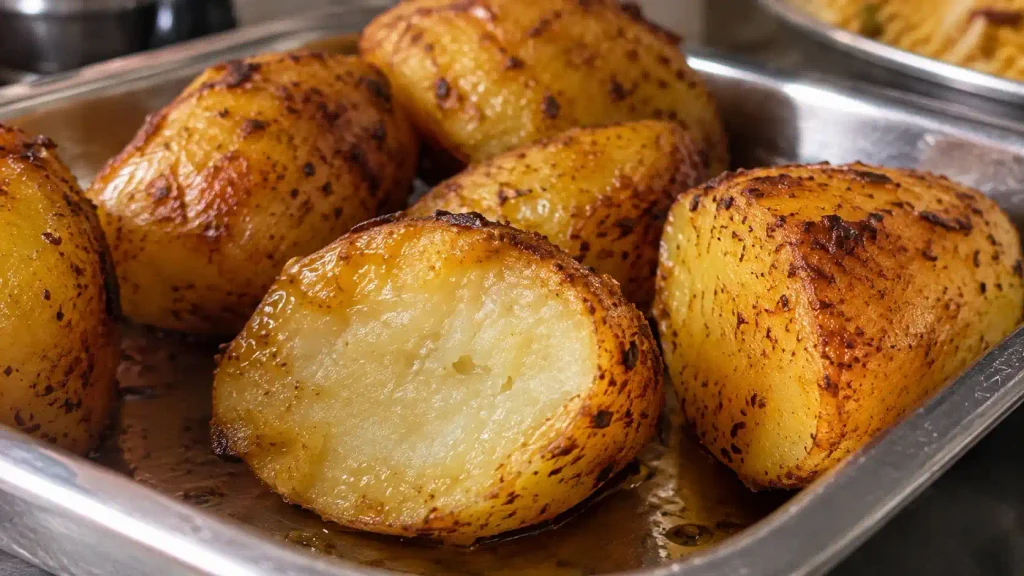
The outside is faintly crisp from initial frying; the inside is soft in a way that carries everything around it. Finding that potato on the plate is, for many Kolkatans, a small but genuine moment.
It is not padding. It is a receiver. And size matters—large halves of starchy potatoes like Jyoti, not cubes, not baby potatoes. The potato needs mass to absorb without collapsing.
The potato question has its own story. We’ve covered the full history and theories in detail why Kolkata biryani has a potato – if you want to read the deeper version.
For a detailed look at the competing origin theories, this piece on the history of the potato in Kolkata biryani is worth reading.
Before You Start
| Servings | 8–10 |
| Prep time | 45 minutes |
| Marination | 2 hours minimum, overnight preferred |
| Active cooking | ~2.5 hours |
| Dum + rest | 40–45 minutes |
| Total time | Approx. 4 hours + marination |
| Difficulty | Moderate-high |
| Rice | Aged long-grain basmati |
| Mutton | 2 kg bone-in, 125–150g pieces |
| Flavour profile | Fragrant, lightly spiced, not hot |
Ingredients for Kolkata Mutton Biryani
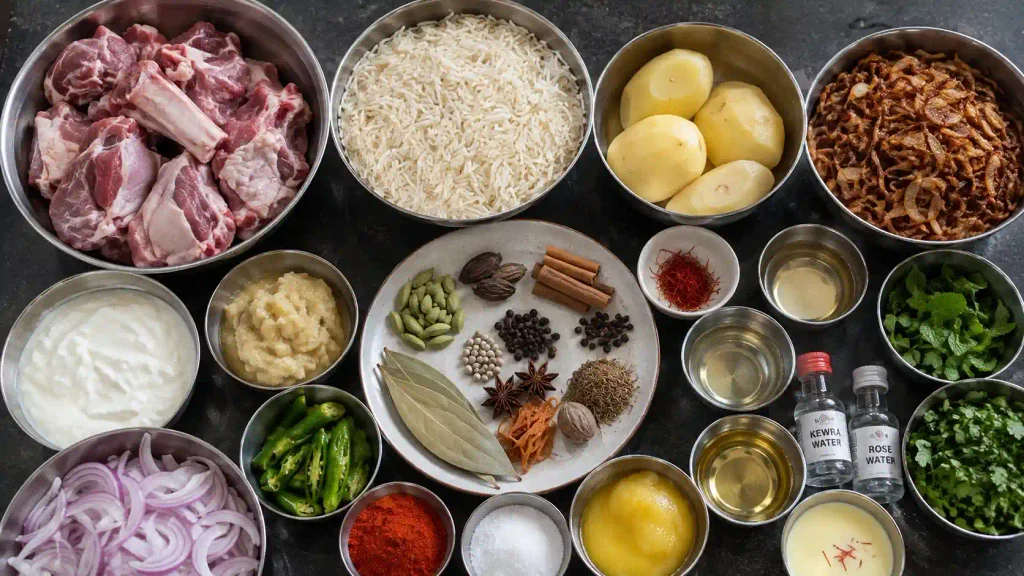
- For the mutton: 2 kg bone-in mutton (leg and rib pieces, 125–150g each) · 200g hung yoghurt (strained overnight from ~350g regular yoghurt) · 60g ginger paste · 45g garlic paste · 6g red chilli powder · 25g salt · biryani masala (see below)
- For the rice: 1 kg aged long-grain basmati (soaked 2 hours) · 6 litres water + 90g salt · spice potli: green cardamom, black cardamom, cloves, cinnamon, bay leaves · 10g kewra water · 5g white ghee · juice of half a lime
- For the potatoes: 1 kg Jyoti potatoes (~200g each), peeled and halved · yellow food colour + salt · oil for frying
- For birista: 150g onion, finely sliced · 140g vegetable oil · pinch of salt
- Biryani masala 1 (roasted): Dry-toast together: green cardamom, black cardamom, cinnamon, cloves, black peppercorn, white peppercorn, kababchini, nutmeg, mace, star anise, bay leaf, shah jeera, cumin seeds — then add dried rose petals off the heat. Grind fine. You need 8g total across the recipe.
- Biryani masala 2 (unroasted): Green cardamom and mace only, ground raw without toasting. 8g total. These are used separately at different stages; the combination produces Kolkata biryani’s characteristic layered fragrance.
- Aromatics for layering: 85g kewra + 85g rose water + 8 drops meetha attar (essence mix) · 20g warm milk + saffron threads (saffron milk) · 250g warm milk + biryani masala + salt (masala doodh) · 75g white ghee · 40g khoya (crumbled) · 40g alu bukhara · mutton stock (~300g) and rogan (~200g) from cooking
Choosing Mutton and Rice
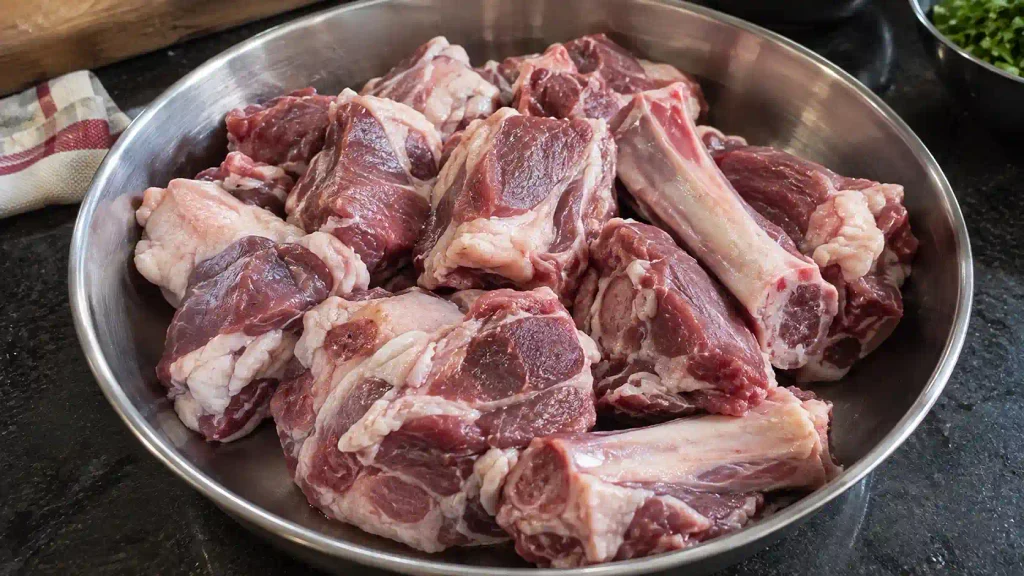
Mutton. Bone-in is essential—the marrow and collagen released during cooking give the rogan and stock their depth. Leg and seena pieces work best. Ask your butcher for large chunks; they will shrink a little as fat renders. Very small pieces disintegrate on dum.
Rice. Aged basmati is not optional. New rice will overcook during dum and ruin the texture. Look for rice stored at least a year; reliable brands include Wagah Royale, Kohinoor Royal and Daawat. Soak for 2 hours—the grain should lengthen and soften before cooking begins.
The Biryani Masala
Kolkata biryani masala is not a generic garam masala. Proportions matter more than the individual spices themselves.
The roasted masala carries warming, woody depth—cardamom, black pepper, kababchini, mace, nutmeg. The unroasted masala (green cardamom and mace, raw-ground) adds fresh aromatic lift at the layering stage. Using both, at different points, produces the rounded fragrance that makes Kolkata biryani recognisable.
Adding more masala does not improve the biryani. An excess of any single element—masala, kewra, meetha attar—is one of the most reliable ways to unbalance the whole thing. The fragrance should read as complex and slightly heady, not identifiable as any one spice.
How to Make Kolkata Mutton Biryani
Step 1 — Marinate the mutton
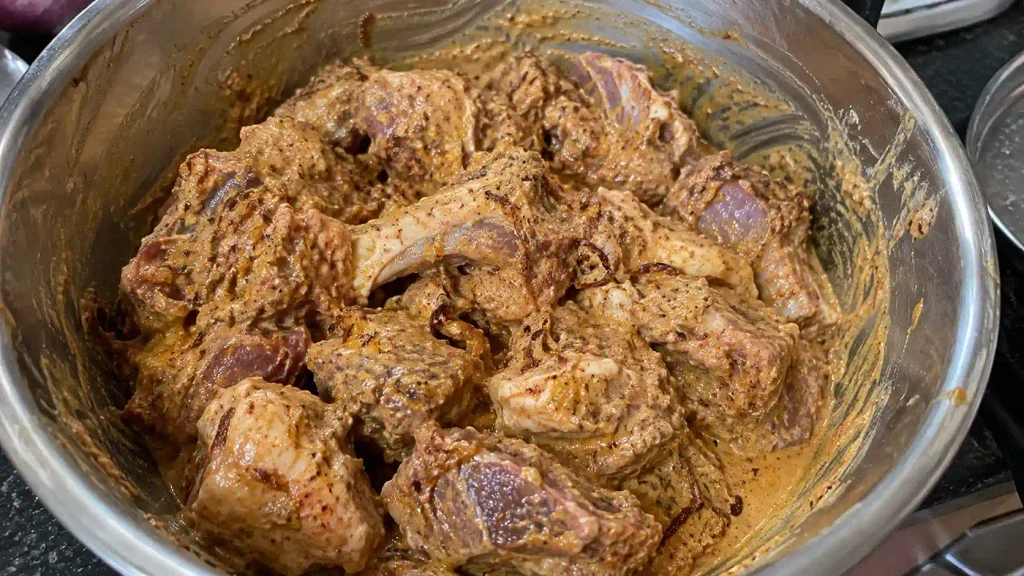
Combine mutton with hung yoghurt, ginger-garlic paste, red chilli, salt, and a small measure of both biryani masalas. Marinate at least 2 hours; overnight gives noticeably better results. The yoghurt tenderises; the spices penetrate.
Step 2 — Make birista
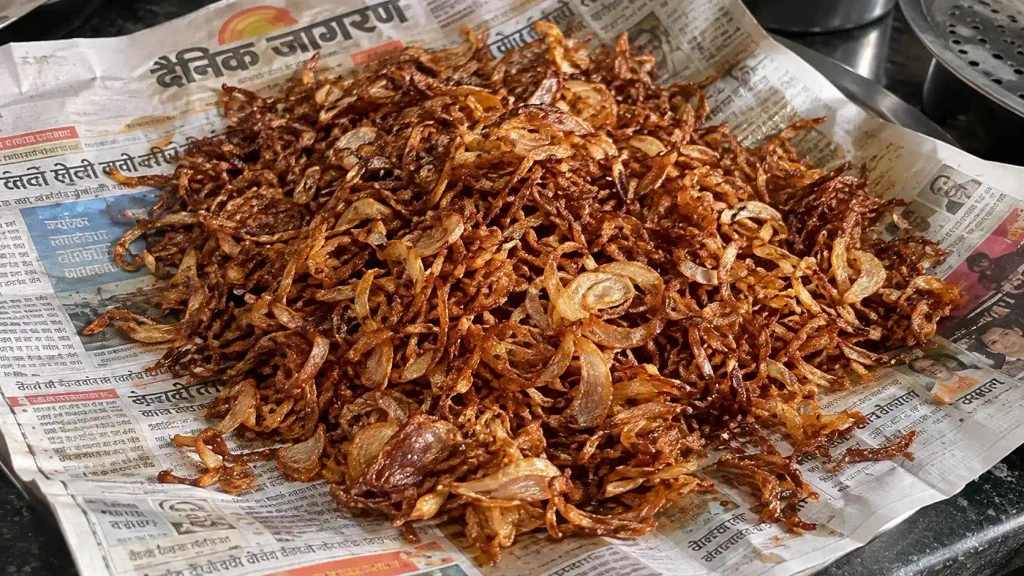
Fry sliced onions in oil over medium-high heat, stirring constantly until deep golden. Remove immediately—residual heat carries them further. Spread on a plate to crisp. Once cool, crumble roughly and set aside. Good birista is golden, shatters when pressed, and smells of caramelised onion, not burnt.
Step 3 — Fry the potatoes
In the same oil, fry the colour-coated potato halves until golden on the outside and about 70% cooked through. Add a little water, cover and cook until almost done. Uncover and dry off residual moisture. The potato should hold shape completely but yield easily to a fork.
Step 4 — Cook the mutton
In remaining oil plus white ghee, temper whole spices (bay leaf, both cardamoms, cinnamon, cloves, peppercorns, kababchini). Add sliced onions, brown well. Add marinated mutton and braise on medium heat 25–30 minutes, until the raw spice smell disappears and the fat begins to separate. Add both biryani masalas. Transfer to a pressure cooker with 300ml hot water. Cook 15 minutes under pressure. Allow steam to release naturally.
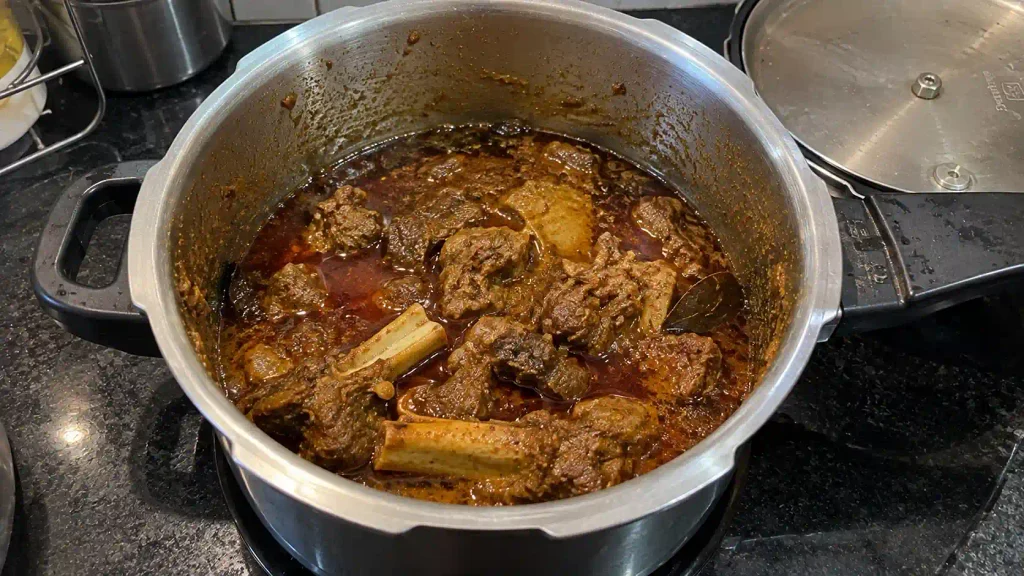
From the cooled pressure cooker: skim 200g rogan (rendered fat) from the surface and mix with 25g white ghee. Collect ~300g stock. The mutton should hold shape, deeply coloured, easily pierced.
Step 5 — Parboil the rice
Bring 6 litres salted water to a boil with the spice potli, kewra water and ghee. Once aromatic, add soaked rice. Cook until the grain has lengthened and is at about 80% done—it should have a very slight firmness at the very centre when bitten. Drain immediately. Do not rinse.
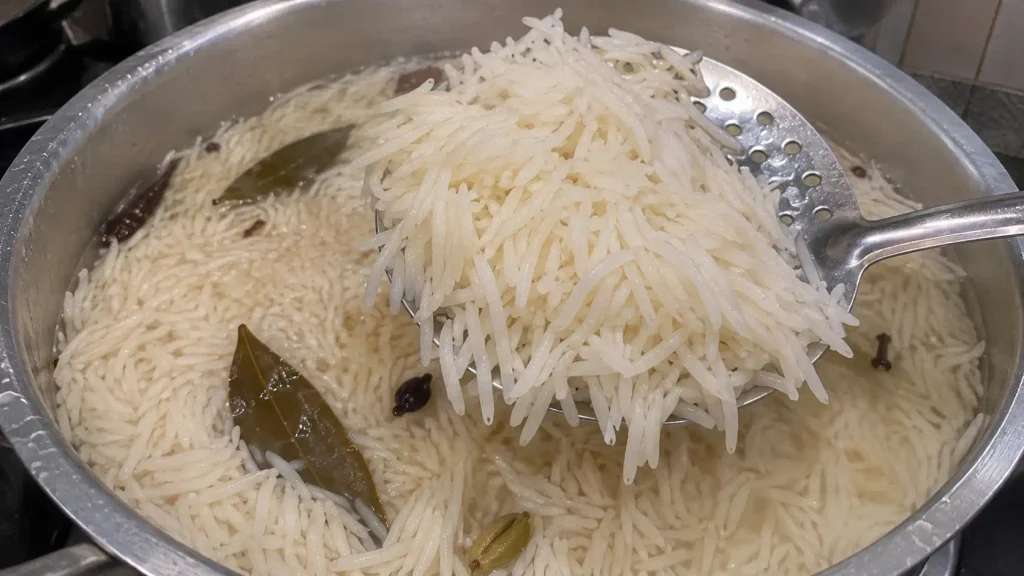
Step 6 — Layer the biryani
Grease the handi base with ghee. Add all the mutton stock, a squeeze of lime, masala doodh, alu bukhara, and shahi garam masala. Layer all mutton pieces and potato halves. Scatter birista, masala, khoya, and essence mix over the meat. Add half the rice; pour over half the rogan-ghee mixture, more masala, birista, masala doodh and saffron milk. Repeat with remaining rice and aromatics. The top layer should have saffron milk streaked across it.

Step 7 — Seal and dum
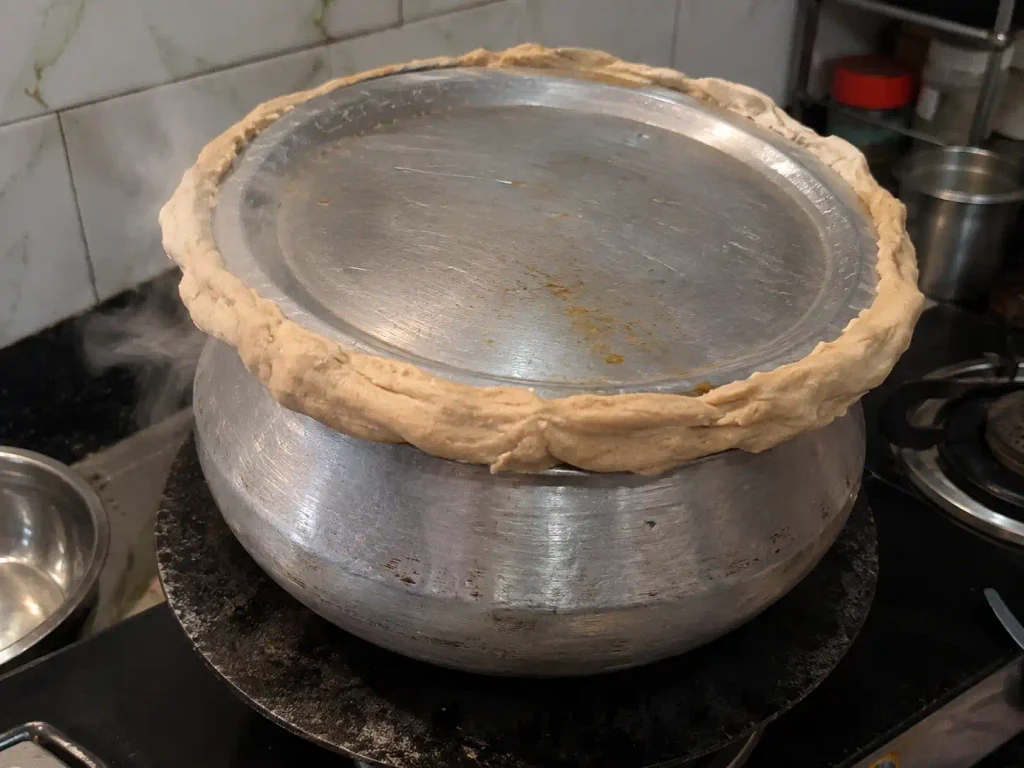
Seal the lid with atta dough, leaving a small gap. Place over high direct heat for 6–10 minutes, then transfer to a preheated tawa (iron griddle) and cook on medium-low for 25–30 minutes. Steam appearing through the dough gap and a sound that shifts from bubbling to a soft crackle indicates the dum is complete. Switch off heat; rest 10–15 minutes before opening.
Don’t Just Follow the Clock — Look for These Signs
- Rice at 80%: Press a grain between fingers—it yields but resists slightly at the very centre. Not chalky, not soft.
- Birista done: Deep gold, shatters when pressed. If it bends, it needs more time. If it’s dark brown, it’s already bitter.
- Mutton ready: Fat separating from the gravy, pieces deeply coloured. A fork should pierce without force.
- Potato at layering: Firm enough that it won’t collapse under rice weight; cooked enough that the interior is soft.
- Dum complete: Steam through the gap, crackling sound at the base. The fragrance will come through even a sealed lid.
- After resting: Top rice separate and fully cooked. No standing liquid at the bottom of the handi.
Common Problems and Fixes for a perfect Kolkata Mutton Biryani
| Problem | Likely Cause | Fix |
|---|---|---|
| Mushy rice | Overcooked before layering, excess liquid | Cook rice to 80% only; measure stock carefully |
| Dry mutton | Insufficient stock or rogan in bottom layer | Always include measured stock and rogan in layer one |
| Tough mutton | Under-pressure cooked, or mature animal | Longer yoghurt marination; add 5 minutes to pressure cooking |
| Overpowering perfume | Excess kewra water or meetha attar | These go further than expected — reduce quantities |
| Raw-tasting spices | Masala not cooked into mutton sufficiently | Braise biryani masala into the meat for at least 5 minutes |
| Burnt base | Direct flame during full dum period | Always use a tawa (iron griddle) as heat diffuser throughout dum |
| Potato falling apart | Overcooked before layering | Stop cooking while the potato still holds its shape completely |
| Bland biryani | Underspiced marinade or incorrect masala ratio | Check biryani masala proportions; ensure marinade has sufficient salt |
What to Serve With It
Kolkata biryani is a complete meal. It doesn’t need much. Sliced cucumber or a light shorsha kakur salad cuts through the fat well. Rezala—a mild white mutton curry—is the traditional restaurant accompaniment. A plain, lightly seasoned raita provides cooling contrast. Mishti doi or phirni is a natural finish.
Avoid heavy, heavily spiced curries alongside it. They fight rather than complement the biryani’s restrained fragrance.
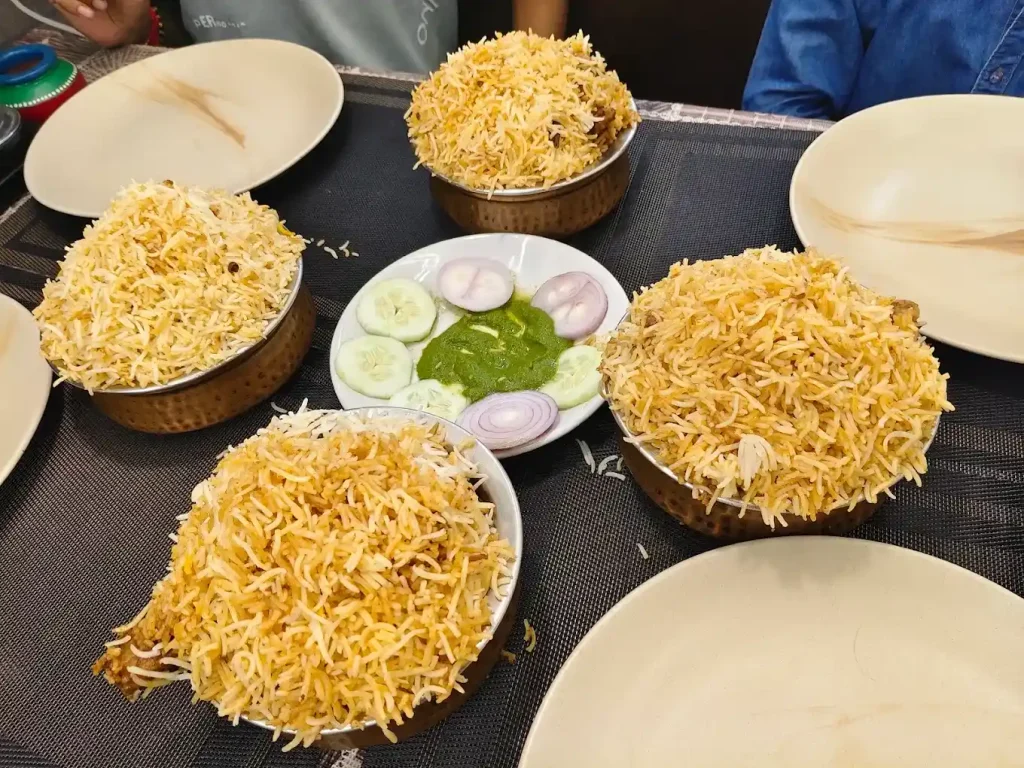
If you’d rather eat a proper plate than cook one, check out our guide to the best biryani in Jadavpur including where locals actually go.
Storing and Reheating
Refrigerate within two hours of cooking; keeps for 2–3 days in an airtight container. To reheat, add 2–3 tablespoons water to a heavy-bottomed pan, add biryani, cover and warm on low for 8–10 minutes. This gently re-moistens rice without drying the mutton. Microwave works in a pinch—a splash of water, a damp paper towel over the container, 90-second bursts. Don’t overheat; rice firms quickly once it dries.
Kolkata vs. Lucknow vs. Hyderabadi Biryani
| Feature | Kolkata | Lucknow | Hyderabadi |
|---|---|---|---|
| Origin | Awadhi, adapted in Calcutta | Awadh (Uttar Pradesh) | Deccan |
| Potato | Yes — large halves | No | No |
| Meat preparation | Pre-cooked, then layered | Pukki dum (partly cooked) | Kachi dum (raw meat layered) |
| Rice colour | Faint gold | Pale ivory | Deep saffron-orange |
| Spice level | Mild, aromatic | Very mild | Moderate to hot |
| Key aromatics | Kewra, rose water, meetha attar, saffron | Kewra, rose water, saffron | Saffron, mint |
| Ghee type | White ghee | White ghee | White or desi ghee |
| Signature addition | Aloo, alu bukhara, khoya | Very delicate whole-spice flavour | Fried onions, raw-meat dum technique |
What makes Kolkata mutton biryani different from other biryanis?
The combination of aloo, restrained spicing, white ghee, meetha attar, and dum cooking. It is fragrant rather than spicy, and distinctly Awadhi in lineage but locally evolved.
Why does Kolkata biryani have potato?
Historical accounts point to the chefs of Nawab Wajid Ali Shah adapting their recipes after he was exiled to Calcutta in 1856. Whether the aloo entered as an economy measure or as a prestigious ingredient is genuinely debated—both theories have been put forward by credible sources.
Is Kolkata biryani spicy?
Mildly spiced, not hot. The dominant character is aromatic. Red chilli is present but restrained.
Which rice is best?
Aged long-grain basmati. Wagah Royale, Kohinoor Royal and Daawat are frequently referenced by experienced cooks.
Which mutton cut works best?
Bone-in leg and rib (seena) pieces, approximately 125–150g each.
Does Kolkata biryani contain egg?
Some traditional versions included a boiled egg. Today most Kolkata restaurants don’t include it as standard; it’s optional at home.
Can I make it without meetha attar?
Yes, but the signature Calcutta-Mughlai aroma will be noticeably different. In Kolkata, Park Circus and New Market areas stock it. Online, Tekka and Deer brand are commonly recommended.
Can I skip kewra water?
You can, but kewra adds a distinctive floral-green note that is part of the biryani’s identity. The dish will be good; it won’t be classically Kolkata.
How long should mutton marinate?
Minimum 2 hours. Overnight gives significantly better penetration and texture.
Why does my biryani become mushy?
Almost always because the rice was cooked past 80% before layering. Cook less; trust the dum to finish it.
How long is the dum?
25–30 minutes on indirect heat over a tawa, plus 10–15 minutes resting before opening the seal.
How much rice for 1 kg mutton?
500g rice is the standard ratio. Scale up—2 kg mutton needs 1 kg rice, serving 8–10 people.